Two rules that got everyone talking
In February 2026, the AI team at StrongDM, an American security company, published the charter of its "Software Factory". It fits in two sentences:
- Code must not be written by humans.
- Code must not be reviewed by humans.
The second rule made a lot of developers jump, me included. Everyone knows an AI can write wrong code with complete confidence. Not reviewing it anymore sounds reckless.
But that charter wasn't an isolated case. Within a few months, OpenAI, Cloudflare, Warp and others published their own take on the same idea. Software factory became the topic of the year in AI-assisted development.
So, passing trend or real shift? And above all: what does it change for you, if you build an app or have one built?
What is a software factory?
A coding agent like Claude Code or Codex is a very fast craftsman at your workbench. You ask for something, it does it, you look at the result, you ask for the next thing. You stay next to it the whole time. If that way of working is new to you, start with the agentic coding guide.
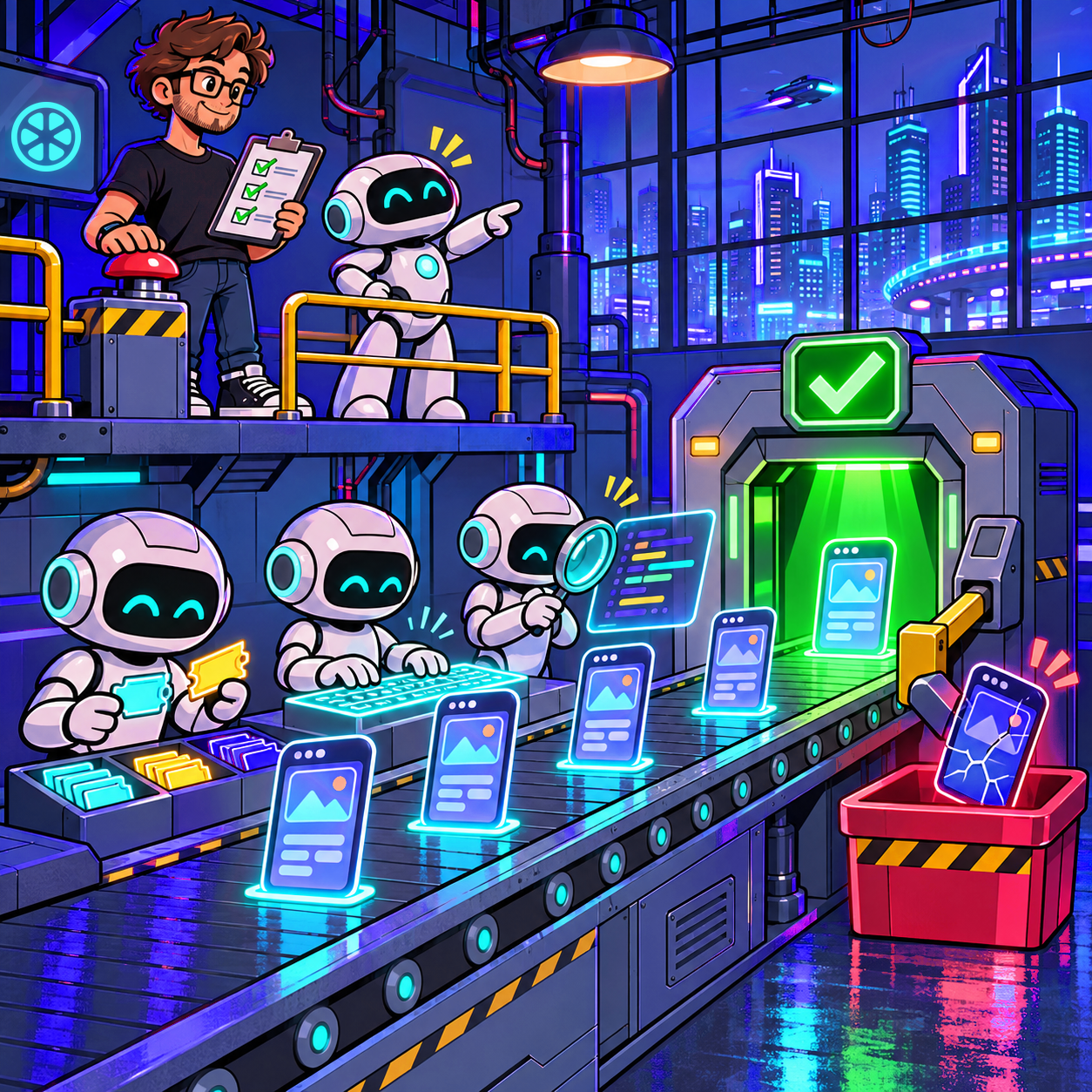
A software factory is the assembly line. Several agents work in parallel, each at its own station, without you standing behind them:
- one agent sorts incoming requests (bugs, ideas, tickets);
- one agent writes the specification: what exactly needs to be done and how to know it's done right;
- one agent codes;
- another agent reviews that code;
- automated tests check that nothing is broken;
- a last station monitors what happens once it's live.
A ticket goes in on one side, a tested change comes out on the other. Humans no longer step in at every stage, only at decision points: approving a spec, accepting a release, settling things when the line gets stuck.
The idea is over 50 years old
The word is nothing new. In 1968, Bob Bemer, a computing pioneer, was already talking about a "software factory". In 1969, Hitachi opened what is considered the first software factory in Japan, soon followed by Toshiba, NEC and Fujitsu. In 2004, Microsoft published an entire book called Software Factories.
All these attempts hit the same wall. You can standardize how a car is built because every car of a given model is identical. Every piece of software is different. And the worker on the line was still a human developer: expensive, slow to train and impossible to copy. The factory organized the work better, but it didn't make it faster.
What changed in 2026 is the worker. An agent costs a few dollars an hour, works at night, and you can start twenty at once. For the first time, the factory has workers you can multiply.
2026, the year everyone built a factory
In a few months, the topic went from enthusiast blogs to company announcements:
- January. Steve Yegge, a well-known developer, releases Gas Town, a tool to run dozens of agents at the same time. The same month, Dan Shapiro proposes a five-level scale inspired by self-driving cars: from souped-up autocomplete all the way to the dark factory, the factory that runs with the lights off because no human works there.
- February. StrongDM publishes its charter. Humans write the specifications, design the test scenarios and watch the scores. They no longer look at the code.
- April. OpenAI releases Symphony, a system that plugs its Codex agents straight into a ticket tracker. The finding behind it stuck with me: the agents were capable, but engineers couldn't keep up with that many sessions in parallel. The bottleneck was human attention.
- August. Cloudflare explains how a chain of agents brought the open issues on the Astro project from over 200 down to about 30. The same month, Warp launches a product to build your own factory, and says it already automates about 30% of its own tasks.
One caveat: almost all of these numbers come from the companies themselves. Nobody has verified them independently yet. That doesn't make them false, but they are shop windows.
What really changes: code is no longer the bottleneck
The most interesting part isn't speed. It's where the work moves to.
In a traditional factory, the best-paid people aren't on the line. They're in the design office, which decides what to build, and in quality control, which decides whether a part is good. Software factories reproduce exactly that.
At the input: knowing what to build. A chain of agents executes a clear request very well. It also executes a vague request very well, and then it produces the wrong thing very fast. A ticket saying "improve the checkout page" gives you nothing useful. A ticket saying "customers must be able to pay in three installments above €200, and see the schedule before confirming" gives you a result.
At the output: proving it works. If nobody reviews the code, you need something else to know whether it's right. At StrongDM, that's scenarios: concrete situations a user could go through, replayed automatically on every change. It's the same idea as the part of the harness that doesn't go away: tests, CI (the robot that reruns every test on each change), restricted access and production monitoring.
My take: the "no human review" rule isn't recklessness, it's a bet on verification. StrongDM doesn't trust the agents. It built enough automated checks that it no longer needs to read every line. Without those checks, the same rule would be suicidal.
Why you don't need a factory (yet)
There's a reason these examples come from large tech teams: a factory pays for itself through volume.
Cloudflare had 200 pending issues on a heavily used open-source project. Warp has hundreds of small repetitive tasks. StrongDM sets a benchmark that says a lot: if you haven't spent at least $1,000 on tokens (what you pay to run the AI) per engineer per day, your factory still has room to improve.
Your app might have 50 users, a handful of features and a backlog that fits in a note. Building a six-agent line for that is like building a car plant to make three bicycles.
There's a more serious risk. A factory amplifies what's already there. If your project has solid tests, clear instructions and a CI that blocks, it quickly produces correct work. If your project has none of that, it quickly produces wrong work, in volume, with clean code that inspires confidence. AI often nails the hard part and misses the obvious, and a line without quality control multiplies the obvious mistakes.
And then there's accountability. If your app handles payments or health data, "no human reviewed this code" is a hard sentence to defend in front of a customer, an insurer or a judge. Legal scholars at Stanford have pointed out that current liability rules never imagined software that nobody has reviewed.
What you can borrow from factories today
You don't need a factory. You do have every reason to work as if you were going to have one. The same habits make a single agent more reliable.
- Write tickets, not conversations. Before starting your agent, write three lines: the context, the expected result, and how you'll know it worked. If you can't write the third line, the request isn't ready.
- Turn your "it has to work" into scenarios. "A new user signs up, gets their email, logs in and sees an empty dashboard." Ask your agent to make it an automated test. Start with the three flows that keep your business alive.
- Separate the writer from the reviewer. Don't ask the agent that just wrote the code whether it did a good job: it will say yes. Open a new session, with another tool if possible, and ask it to look for problems.
- Make the tests run on their own. A CI that reruns your tests on every change is the first quality station in any factory. It's also the most profitable one.
- Measure what comes back. Track how many of your agent's changes you accept as is, and how many you have to rework. If you rework almost everything, the problem is rarely the agent: it's the instructions or the tests.
- Keep the decisions. What to build, anything touching payments, authentication and personal data: you, or someone you trust, signs off.
If you already do all of this, you're not far from the point where a small chain of agents starts to pay off. If you do none of it, a factory won't help you: it will just produce the problems you already have, faster.
So, the end of developers?
Software factories don't remove the work, they move it. Fewer people are needed to type code, and more are needed who can say what to build and check that it's built right. The developer becomes the factory manager: they design the line, write the specs, set up the checks and step in when something comes out wrong.
The good news for you is that code keeps getting cheaper. The bad news is that cheap code doesn't make a good product. Two teams with access to the same agents will ship very different apps, depending on the quality of what goes into the line and the rigor of what checks it at the end. That's also why agents don't replace the people who know how to manage them.
The software factory is arriving, for real this time. But like every factory, it's only as good as its design office and its quality control.
Want a factory manager for your product?
I build apps with AI agents while keeping both ends of the line for myself: understanding what your product needs to do, and proving that it does it, with tests on your critical flows, a CI that blocks before things break and human review where it matters. If you want to hand over your product, see the offer or let's talk about your project. If your app already exists, a code audit tells you whether it's ready to be handed to agents.
For more articles on building products with AI, subscribe to the newsletter.